
Filer vs Non-Filer in Pakistan: What Staying Outside the Tax Net Really Costs
Being a non-filer in Pakistan is no longer a quiet choice. It is an expensive one, and the cost shows up on almost every major transaction, from buying a plot to withdrawing cash from your own bank account.
This article explains the difference between a filer and a non-filer, what that difference costs in practice, and how to move onto the Active Taxpayer List (ATL). Rates quoted are for tax year 2027, effective 1 July 2026, following the Finance Act 2026.
What is a filer?
A filer is a person or business whose name appears on the FBR's Active Taxpayer List. You get there by registering for a National Tax Number (NTN) and filing your annual income tax return on time. A non-filer is anyone who is not on that list. Under the Tenth Schedule of the Income Tax Ordinance, 2001, a person who is not on the ATL generally pays withholding tax at double the standard rate, and on some items considerably more.
What non-filers pay
| Transaction | Filer | Non-filer |
|---|---|---|
| Property purchase (section 236K) | 1.25% | 10.5% to 18.5%, by value |
| Property sale (section 236C) | 2.75% | 11.5% |
| Cash dividend (section 150) | 15% | 30% |
| Payments to a company for services (section 153) | 14% | 28% |
| Vehicle registration (section 231B) | Standard rate | Three times the filer rate |
| Large cash withdrawals (section 231AB) | Nil | Extra withholding applies |
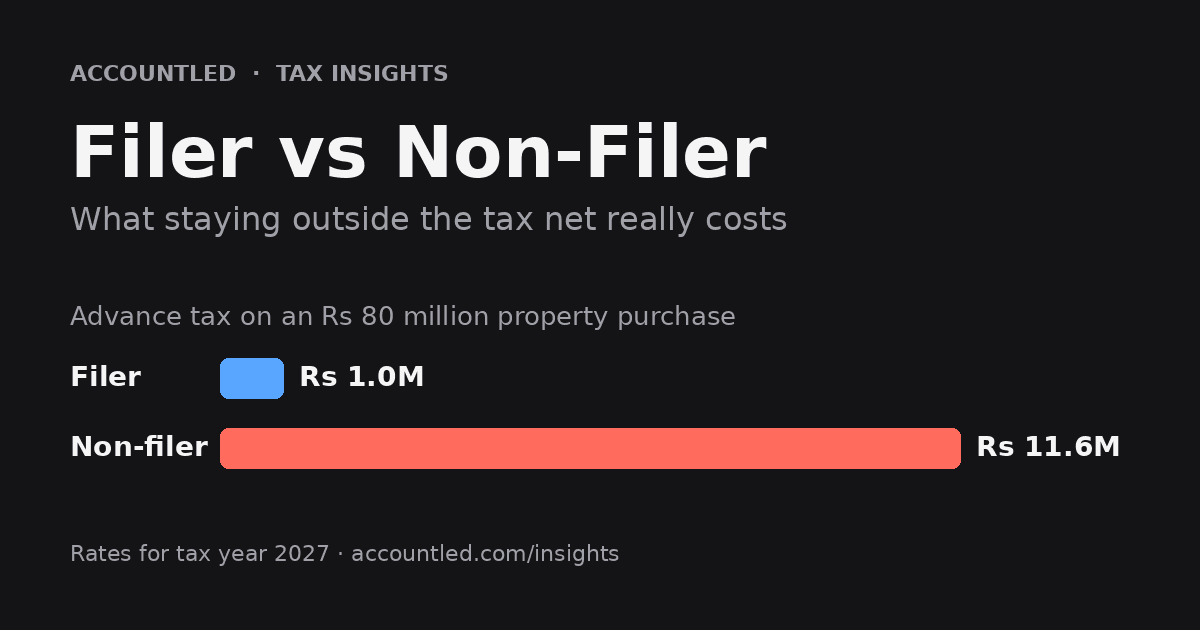
A worked example makes the gap clear. On a property purchase of Rs 80 million, a filer pays Rs 1.0 million in advance tax. A non-filer, in the 14.5% band, pays Rs 11.6 million. That is a difference of Rs 10.6 million on a single transaction, and filing a return costs a small fraction of it.
The costs beyond tax rates
- Everyday charges. Non-filers also face withholding on items such as large electricity bills and telephone and internet bills, which filers do not pay.
- Lost refunds. Most withholding tax is adjustable. A filer can offset it against annual liability and claim back any excess. Without a return, that money is simply gone.
- Weaker financial standing. Banks, lenders and other institutions find it harder to assess a person with no filed return, which can slow down loans, financing and business accounts.
Benefits of being a filer
- Much lower withholding. on property, vehicles, dividends, bank profit and business payments.
- Refunds. of excess adjustable tax, which non-filers cannot claim.
- Cleaner paperwork. for banks, dealers, registrars and overseas applications, because your income is on record.
- Fewer surprises. since a consistent filing history makes FBR notices and audits easier to answer.
- Freelancer and exporter relief. IT and IT-enabled service exports carry a concessional 0.25% rate for tax years 2026 to 2029, and filers pay half the rate that non-filers pay on social media platform revenue.
More restrictions may be coming
Section 114C, inserted by the Finance Act 2025, would stop an "ineligible person" from buying a car above Rs 7 million, transferring property above Rs 100 million or investing more than Rs 50 million a year in securities. Eligibility would require a filed return and enough declared resources, not just a place on the ATL. As of 19 October 2026 the section is in the law but has not been brought into force, because the government has yet to notify a start date. It is a strong signal of the direction of policy, and a good reason to get your records in order now.
How to become a filer
- Register on the FBR IRIS portal and obtain your NTN.
- Prepare your return and wealth statement, even if your income is low or the return is nil.
- File the return. If you have missed this year's deadline, file as soon as you can and ask your adviser about getting back onto the list.
- Check your status by sending ATL, a space, and your 13-digit CNIC to 9966, or search the list on the FBR website.
How AccountLed can help
AccountLed is a full-service accounting and tax firm covering taxation, bookkeeping, audit and advisory. We handle NTN registration, annual returns, wealth statements and withholding compliance for individuals and businesses, so your name stays on the Active Taxpayer List and your records hold up when someone asks to see them. Talk to us and we will tell you where you stand.
This article is general information, not tax advice. Rates and rules can change through the Finance Act, SROs and circulars, so please verify against the FBR website or speak to an adviser about your own situation. Rates last checked 21 October 2026.